|
Location St Kilda Mangrove Adelaide Equipment Zoom H4N DPA 4061& MKH60 Tripod mount and Zoom H4 Hydrophone Oh boy I must be insane! Its 4.00am in the morning and I am up to drive just north of Adelaide to record bird sounds. Years ago I came to the St Kilda Mangrove swamp and did some recordings, but it was much later in the day and there was a lot of background noise. I thought this time I would try to do it properly. I also discovered that I forgot about the half hour time difference between Melbourne and Adelaide, so it’s actually 3.30am!! Anyway this gives me lots of time to get out there, explore and setup. Thankfully the mangroves are accessible at all hours with a trust system of payment by the front gate. (Not that I noticed this until I left because it was so dark when I arrived. But I did pay on my way out. :-) ) I originally planned to use the one hand setup with my mics and carry them around, but I quickly realized it was going to be far more practical to mount everything on the tripod. This would allow me to not only work hands free, but to walk away from the recorder and leave it running which as I have said before can be a really good idea when recording birds and animals. It also left me hands free to deal with the bloody mosquitoes because for the first hour or so before sunrise they were terrible and it drove me nuts. Once the sun was up they disappeared so that was a relief. 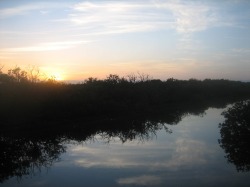 Sunrise over StKilda Magroves Even before sunrise there were some birds making sounds. I setup the gear in a couple of locations and walked away from it to make the birds feel more relaxed and less likely to want to relocate. In this way I captured some good footage. Later however I was to discover that sometimes startling a bird can be useful. Just after sunrise as I was moving back through the boardwalk area I startled what I think was a cormorant, as it took to the air it made a series of grunting sounds that sounded like it was very unimpressed at being disturbed, but it did give me some sounds I would never have gotten otherwise. I don’t like to disturb animals when I record them, but this was harmless and made an otherwise quiet bird somewhat vocal. The range of birds, and as a result bird sounds, changed as the sun rose and the morning advanced. Conveniently for me they seemed to wake up in sequence so I could often get a clean recording of one species before the next one became active. This was obviously just pure luck for this environment but it was still really good for me. After about three hours of recording around the swamp I went outside the mangrove area and recorded a couple of other birds and someone’s grumpy blue heeler dog nearby. Then I packed up and headed down to the boat ramp nearby, it was going to be a hot day and a lot of people were heading out early to do some fishing. 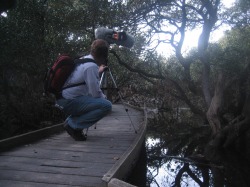 Boardwalk through the mangroves I set myself up on the little floating pier near the boat ramp. I pointed the shotgun mic at the ramp and attached my hydrophone to the H4 and dropped it off the side. This way I could capture the sounds of the engines both above and below the water. I got a fair bit of material, unfortunately there were several boats all leaving at similar times so some of the engines were difficult to record cleanly, but I did manage to get a couple of good clean samples. I should find a boat ramp back in Melbourne and dedicate a morning to boat engines. There is a very big difference in sound depending on the size. I captured several different sizes from a small 25cc right up to a fairly large 150 cc motor. It was half an hour well spent and the breeze from the water was nice and cool. Today was going to get very hot. Time for some sun block I think. 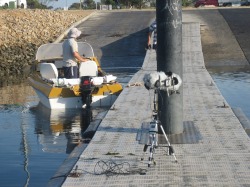 Note the cable trailing into the water When I came here several years ago I also recorded some sounds in the nearby playground. I wish there had been playgrounds like this when I was young. It was huge and had tons of really cool rides and things to climb on, over and under. So after applying some sun block I walked over to the playground. As I was walking around I noticed a mother and daughter playing on a basic carousel, it was old and a little rusty and was squeaking so the mother took her daughter to the swings, but I thought a squeaky carousel would be a good sound sample, boy was that an understatement. The carousel itself was made of strong iron pipes with wire mesh to sit on. tI was probably ten foot in diameter and as I mentioned, it was getting old and was rusty. This meant that when it was rotated there was friction between the carousel trunk and its base, however as the rate of rotation increased the level of vibrations increased dramatically. With any other piece of equipment this would probably just produce loud scrapping or squeaking, but the carousel was a large round object with supporting beams angled down to the base. It effectively looked like a ten foot speaker cone and when it started vibrating it acted in much the same way. Once I got a some rotation speed up it started to generate noise about the same volume as a loud car engine. This was all from the vibrations being amplified by the shape of the carousel and the vibrations spreading through its structure. It even had a natural reverb effect when it stopped moving like a spring reverb in an old guitar amplifier. I spent ten to fifteen minutes just rotating this thing and recording the samples, it was one of the most amazing things I have ever played with. After a while I worked out that I could alter the pitch dependant on the rate or rotation, so I varied the speed as I was playing with it. If I could have picked the thing up and taken it home I would have, it was fantastic. (and also about a ton of steel I suspect) I think I will need to include this material under the “unusual” category of the library because I really don’t know how else to catalogue it. This has been one of the most productive recording trips I have had in ages, and I still have two days to go. 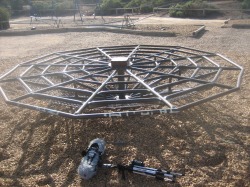 Playground Carousel
0 Comments
Leave a Reply. |
AuthorStephan Schütze has been recording sounds for over twenty years. This journal logs his thoughts and experiences Categories
All
Archives
April 2019
|
 RSS Feed
