|
Location Yandina Queensland Equipment Zoom F4 Sennheiser MKH 60 Boom pole array And Roland R09 Handheld After a successful day at the rifle club it was suggested I come down to the range again the next day as there are three other firearms clubs that all meet on Sundays. I spent most of the day with the North Arm, Sporting Shooters, Shotgun association and Pistol clubs, and I got to record things I would not have dared to dream of. I started with the Sporting shooters club. They have a large range of rifles being used at ranges up to about 100 meters. (The previous day with the 303 was 750 meters!) There was a range of the usual rifles you would expect at a range. .22, 222, .308 as well as air guns and I got the opportunity to record all of these. I also got the opportunity to record 4 different black power flint locks which had fantastic sounds. They were all reproductions of American flintlock rifles from the 1800s but a great deal of detail had gone into making them true and accurate reproductions. The sound of these large calibre muzzle loaded black powder firearms is so different to modern weapons, and from my point of view far more interesting. A flintlock fires its round by having a small spring-loaded hammer released when the trigger is pulled. The tip of the hammer holds some flint that sparks when the hammer hits. The spark ignites the powder which then explodes and projects the round out of the barrel. In modern fire arms all of this happens inside the shell case and so there is just a single “bang” sound. With a flintlock you can actually hear the individual elements. The hammer impact, the ignition of the powder on the receiver plate and the final discharge of the main powder as the weapon fires can all be heard (although in very quick succession) This results in a great sound when the weapon is discharged. I was also lucky enough to record an old 1930’s Russian bolt action rifle from World War Two. This thing had a monstrous sound as it was fired. I spoke to the owner who kindly gave me a lot of information. This model was the rifle made famous in the Hollywood movie Enemy at the gate as the Russians main sniper rifle. It is a very accurate weapon over quite long ranges. I also managed to record some lever action rifles which are like the old style cowboy rifles. 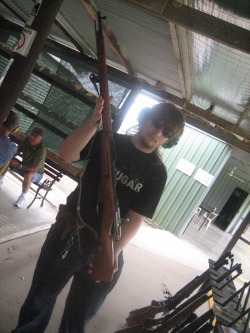 Russian 1930 Mosin Nagant Rifle After the Sporting Shooters range, I moved on up to the Shotgun Association range. They were having a competition day and so I went along with one group as they moved through the different stations. At each point I would set up the R09 a little back from the shooters position, mainly to avoid it overloading the levels, but also to get a less direct sample. Again I initially used the MKH60 to try and capture both loading and firing sounds by quickly switching the input gains from minimum to maximum. In some instances I would leave the levels at max to capture all the extraneous sounds of the gun knowing I would need to discard the gun firing sound as they would be much too loud. It becomes a bit of a balancing act when recording sounds with such great extremes of levels. The advantage I had was that by traveling along with a group over the better part of an hour so I had plenty of time to record the material I needed. It is important to keep this in mind when recording. Not every single sound you record needs to be perfect and usable. If you have already recorded a shotgun being fired 10 times and you know you have at least a few nice clean samples with good levels, then you have the freedom to set the levels to record other aspects of the gun such as loading, cocking or just subtle general movements. Setting the levels high enough to capture these aspects will more than likely result in the levels overloading whenever the gun is fired, but as you already have firing sounds this should not be an issue. Time is the real issue when recording. If it is a random opportunity to record something you would otherwise not get a chance to record then you set the levels as best as time permits and hope for the best result. If however you know that the sound will be reliably replayed over a reasonable length of time, then you have the flexibility to be careful and even creative in how you go about recording things. 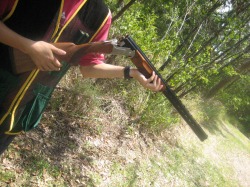 Under Over Pattern Shotgun On the way back down to the clubhouse after the competition I realized I had accidentally captured far more than I originally thought. As the competition consisted of several groups’ rotation through several firing points, it meant that there were shooters firing from many different locations at all times. This meant that while I had been concentrating on the group I was accompanying I had also been simultaneously recording all the other groups. This meant that I captured the sounds of shotguns being fired at just about every range from a couple of inches through to over 100 meters away. This will allow me to add a far greater depth to the shotgun section of the library. As they were all 12 gauge guns I effectively have a very big range of recording of the same sound. This would normally be a very tricky and time consuming result to achieve. Again it’s often the unexpected that gets you the best results. Finally I made my way to the pistol range. It was getting well into the afternoon at this stage and so there were not many people left. One gentleman was very helpful and fired a full clip down range in rapid fire mode allowing me to capture the sounds. I recorded semi automatic pistol at 38 Calibre as well as three revolvers. Finally one of the committee members was preparing his pistol for an up coming competition shoot. His gun was a Tanfoglio 38 super semi automatic and it sounded like a howitzer. The first time he fired the gun I actually felt the shockwave hit me physically. Even with both earplugs and my headphones on (signal switched off) this gun was very loud when fired. 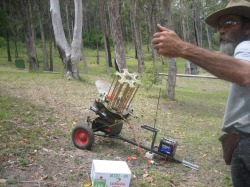 Clay pidgeon launcher I was also able to capture all the Foley of the pistol being loaded cocked and unloaded which was great.
All up this weekend has been a fantastic opportunity to finally record some firearms and get a better feel for what is involved with doing so. There are many obstacles when recording firearms especially when at a range. I would have loved to have carefully record all the Foley sounds for every weapon on the day, but this has issues in itself. Firstly with all the shooting going on it is very difficult to get a nice clean sample of anything else. A weapon discharge is such a short sharp sound that it is often possible to capture good samples even with other guns being fired, but loading, unloading and other Foley sounds are much quieter and can take more time to complete. This means you really need to capture these sounds offsite somewhere else. This could involve organizing the gun owners to meet you, having a suitable location and all of this mean more time especially for the gun owners. The advantage of what I was doing all weekend was that I was recording people doing what they would be doing normally at a range, shooting firearms. Occasionally I would ask them some questions about their firearms, but generally I did not interfere with their day. This makes people far happier to have you around, but if I had asked them to come in especially with their guns to stand around while I recorded all the Foley, this is far less convenient for them and is asking them to sacrifice their time for my benefit. I try as much as possible to record what I can without needing people to go miles out of their way to help me. Sometimes I’m lucky and people will offer the extra time themselves. Until I can afford to pay people for their time I think this is the best balance of capturing the sounds I want without taking up too much of people’s time. www.northarmshotgun.com.au/
0 Comments
Leave a Reply. |
AuthorStephan Schütze has been recording sounds for over twenty years. This journal logs his thoughts and experiences Categories
All
Archives
April 2019
|
 RSS Feed
